
There's a document in my files, a Performance Improvement Plan, that tells me my lesson plans failed to align with the approved curriculum and pacing guide. The requirement, it says, is "non-negotiable."
I couldn't articulate then what I can articulate now: the script assumes the problem of scaffolding is solved. It isn't. It's the core unsolved problem of instruction. And the mathematics of how learning actually works tells us why.
The Power Law Problem
Complex systems—economies, ecosystems, neural networks, and yes, classrooms—don't follow normal distributions. They follow power laws. Most events are small. Occasionally, you get a cascade.
This matters for teaching because it means: most instructional moves won't work. Not because you're a bad teacher, but because that's the expected distribution. You're searching a space where hits are rare and unpredictable, but when you find one, the effect isn't additive—it's multiplicative.
A scripted curriculum assumes you can predict which scaffold will work for which student at which moment. Power law dynamics say you can't. The critical scaffold, the one that restructures understanding, emerges from the interaction itself. It can't be packaged in advance.
Functional vs. Optimal: Fischer's Key Distinction
Kurt Fischer's Dynamic Skill Theory draws a crucial line between two levels of performance:
Functional level is what a student can do without support. It's grinding. Effortful. Attention-draining. The student is performing the motions, but the system isn't cascading. Working memory is overloaded. Engagement decays.
Optimal level is what the same student can do with the right scaffold in place. Not easier problems—the right structural support. The experience shifts qualitatively. Flow becomes possible. Achievement feels real because the student is genuinely operating at a higher skill level.
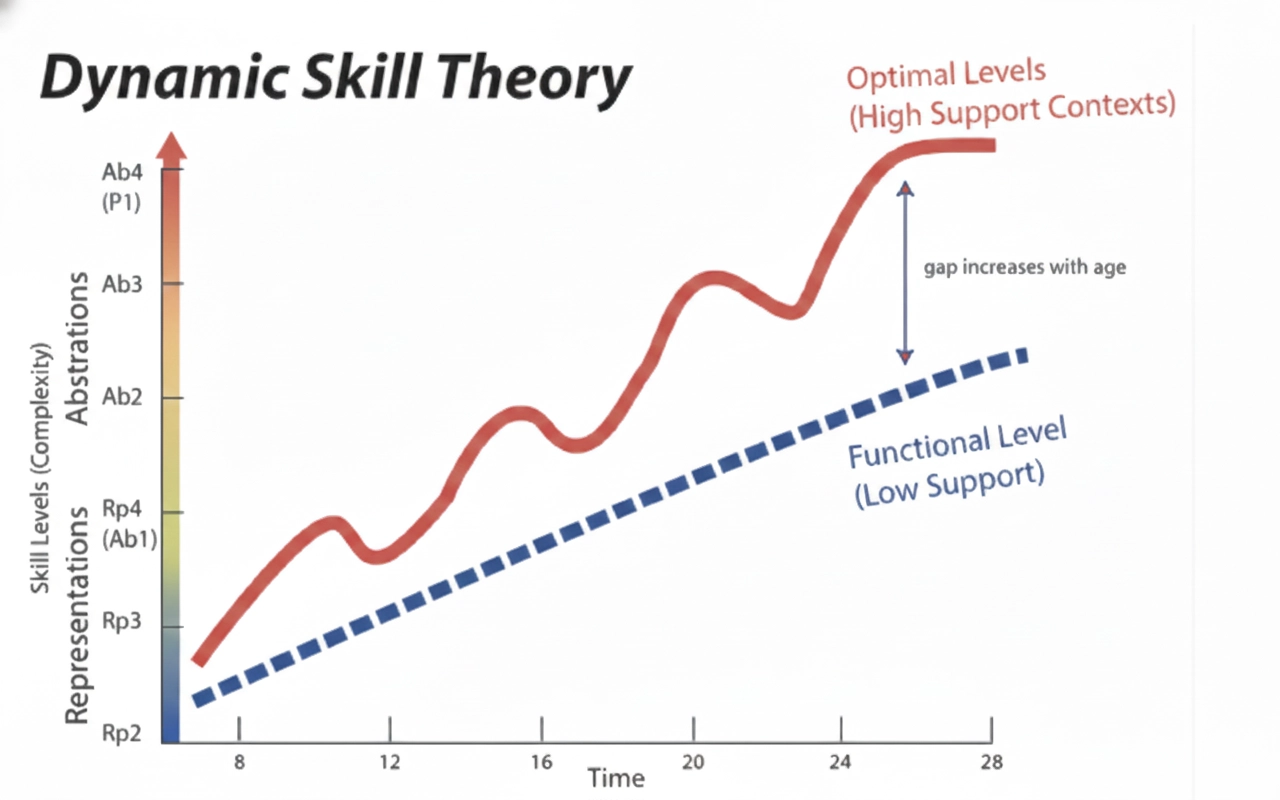
The gap between functional and optimal isn't a gap in the student. It's a gap in the scaffolding. And here's the key: you don't know in advance which scaffold will bridge that gap for this student on this day with this problem.
The Invariants That Matter
Through iteration—through what looks like "wasted" classroom time to an observer with a pacing guide—you discover what's actually missing. Usually it's one of a small set of perceptual anchors:
- Place value understanding that's unstable under pressure
- Multiplication facts that aren't automatic enough to free working memory
- Alignment—the spatial organization that lets structure become visible
These aren't arbitrary supports. They're invariants. When a student has to reconstruct place value during a division problem, they're burning cognitive resources that should be available for the actual mathematical reasoning. The scaffold that stabilizes the invariant is the scaffold that triggers the cascade.
The Lean Startup Logic
If critical scaffolds are rare, high-impact, and unpredictable, then what's the strategic variable? Iteration speed.
This is the lean startup methodology applied to the classroom: you're not wasting time by failing fast. You're sampling the distribution efficiently. Each "failed" attempt is a probe. Each probe narrows the search space. When you find the scaffold that works, the payoff is nonlinear.
The pacing guide wants you to move at a fixed rate through predetermined content. But learning doesn't happen at a fixed rate. It happens in punctuated leaps—phase transitions—when the right scaffold tips the system across the threshold.
What I Couldn't Say
When I was told my lesson plans didn't reflect the approved curriculum, what I couldn't articulate was this:
I'm not ignoring the curriculum. I'm running a search algorithm that the curriculum can't run because it treats the scaffolding problem as solved. Every minute I spend "off script" is a probe for the invariant that will unlock nonlinear gains. The script gives you functional-level compliance. I'm searching for optimal-level catalysts.
The administrative frame has no category for "productive failure in service of scaffold discovery." It sees deviation. It sees non-compliance. It can't see the search.
The Real Work
Teaching isn't delivery. The lesson isn't a package of content transferred from curriculum to student.
The lesson is a diagnostic probe. It reveals which invariant, when stabilized, will trigger the cascade from functional to optimal. The teacher's job isn't to follow the script—it's to have the perceptual sensitivity and iteration speed to find the scaffold in real time.
This is what I was doing. This is what I couldn't explain. This is what the PIP called non-compliance.
The mathematics of power laws, the developmental science of Dynamic Skill Theory, and the design logic of rapid iteration all converge on the same conclusion: the scripted curriculum solves the wrong problem. The real problem—finding the scaffold that tips a particular student into optimal performance—can only be solved live, in interaction, through deliberate and productive failure.
That's not a bug in my teaching. That's the actual work.
This is why I'm pivoting to MathTabla full time.