
I didn't know multiplication was area until I was 35.
I'd taught math for years by then. I'd done multiplication thousands of times. I knew the standard algorithm cold. Multiply by the ones, shift left, add. But I'd never once thought about why you shift left. I'd never wondered what "add a zero" actually meant. It was just a rule. You do it because that's how it works.
In September 2017, my friend Wes Basinger changed that in about thirty seconds.
September 2017
I was teaching 4th grade math for the first time. Wes and I had been on the same team at Village Tech Schools, eighth grade then tenth grade. I taught history, he taught math. He's a math major and one of the best math teachers I've ever watched work. So when I found myself in front of a 4th grade class with no idea how to teach multiplication beyond the standard algorithm, I reached out to him. He told me, almost offhandedly, that multiplication could be represented as area. That you could build a rectangle where the length and width were the factors, and the area inside was the product.
I had never seen this. Never been taught it. Never encountered it in any training, any textbook, any professional development session in my career.
The next day I had yellow base-ten blocks on whiteboards. 22 × 21. The students built a rectangle, 22 units across and 21 units tall, and the partial products appeared as visible regions. The 2 × 1 corner. The 20 × 1 strip. The 2 × 20 strip. The 20 × 20 square. Four regions, four partial products, total area: 462.
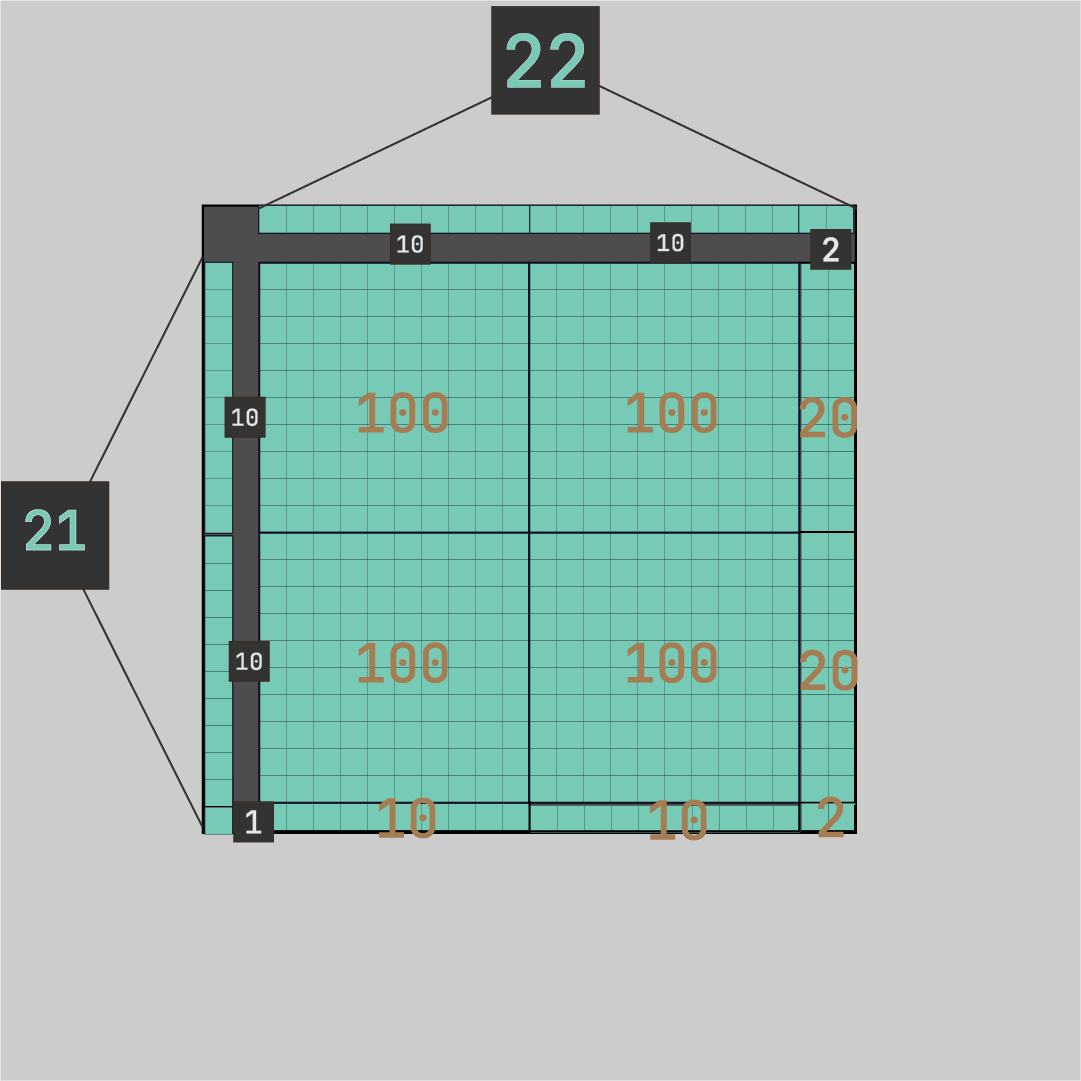
And suddenly "add a zero on the second line" wasn't an arbitrary rule anymore. When you multiply by the tens digit, you're multiplying by a ten. The product is literally ten times bigger. In the area model, that product is a separate region, a wider strip that you can see is ten times the size of the ones-place strip. The zero isn't a trick. It's geometry.
The area model maps directly into the box method. Decompose 22 into 20 + 2, decompose 21 into 20 + 1, and you get four quadrants: 20 × 20 = 400, 2 × 20 = 40, 20 × 1 = 20, and 2 × 1 = 2. Add them up: 462. Same answer, same structure, but now it's abstract and portable.
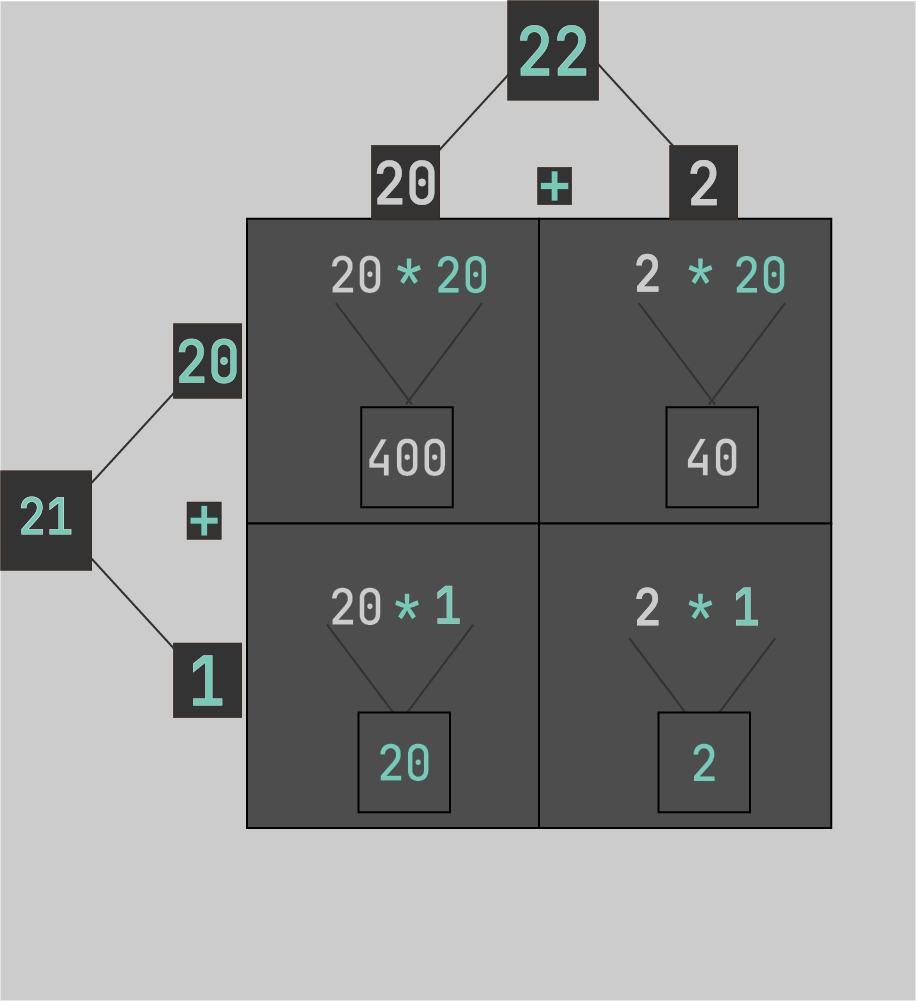
This matters because the area model shows up on the STAAR. Texas tests 4th graders on representing multiplication as area using partial products. It's not a niche teaching strategy. It's assessed. And the box method is the same structure, just without the physical tiles. When students learn it in 4th grade, they're learning a method that will follow them all the way through algebra and beyond. Most of them just don't know that yet.
Look at how the four partial products combine. The 400 and the 2 sit on opposite corners. But the two middle pieces, 40 and 20, come from the cross-sections of the rectangle. From a 4th-grade perspective, you barely notice them. You just add everything up and get 462. But those two middle terms are doing something quietly important. They're the same pieces that, in algebra, become the bx terms you have to find when factoring. They're the pieces you split apart when completing the square. And when you multiply complex numbers, they're the pieces where the imaginary parts either combine or cancel out. Every major technique later in math depends on what happens in those two middle quadrants. Fourth graders don't need to know that yet. But the structure is already there, waiting.
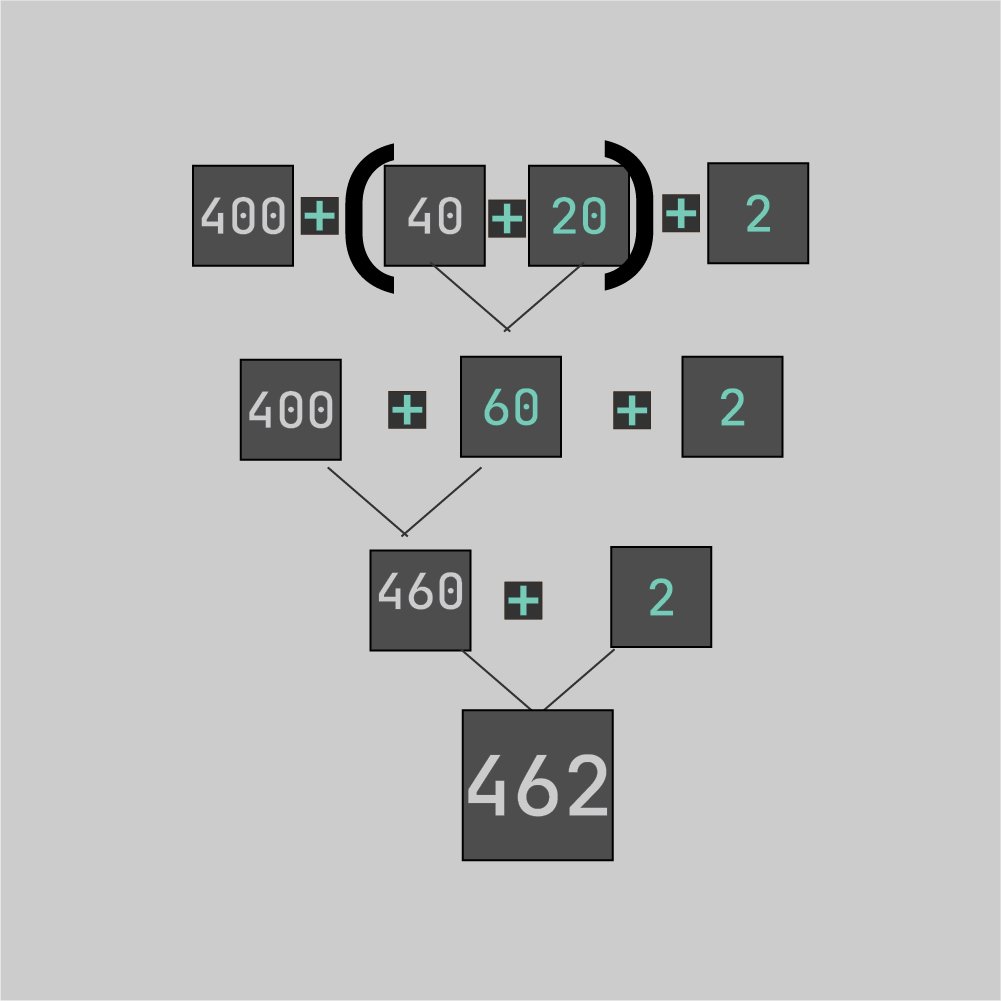
At the time, I thought this was a 4th-grade strategy. A way to teach multi-digit multiplication with understanding instead of rote procedure. I had no idea I was looking at a structure that would follow me for the next nine years.
The Rectangle Meets Algebra
In 2020, I returned to Village Tech Schools, this time to teach geometry. It was the COVID year. The students coming in hadn't finished their algebra course the year before, which meant I had kids taking geometry who still needed to pass the Algebra I STAAR. I talked to Basinger about it, and because I already knew the 4th-grade area model, I decided to use the same structure for algebra tiles.
I didn't use the standard algebra tiles, though. The ones we had were too small. Kids couldn't manipulate them, especially the students who were already struggling. So I found base-ten stamp blocks with different colors and used those instead. Bigger pieces, color-coded, something a student could actually pick up and move around.
The idea was the same as 4th grade: multiplication is area, so represent it as a rectangle. Take (2x + 1)(2x + 2). The rectangle has four quadrants, just like 22 × 21. Top left: 2x × 2x = 4x². Top right: 2 × 2x = 4x. Bottom left: 2x × 1 = 2x. Bottom right: 2 × 1 = 2.
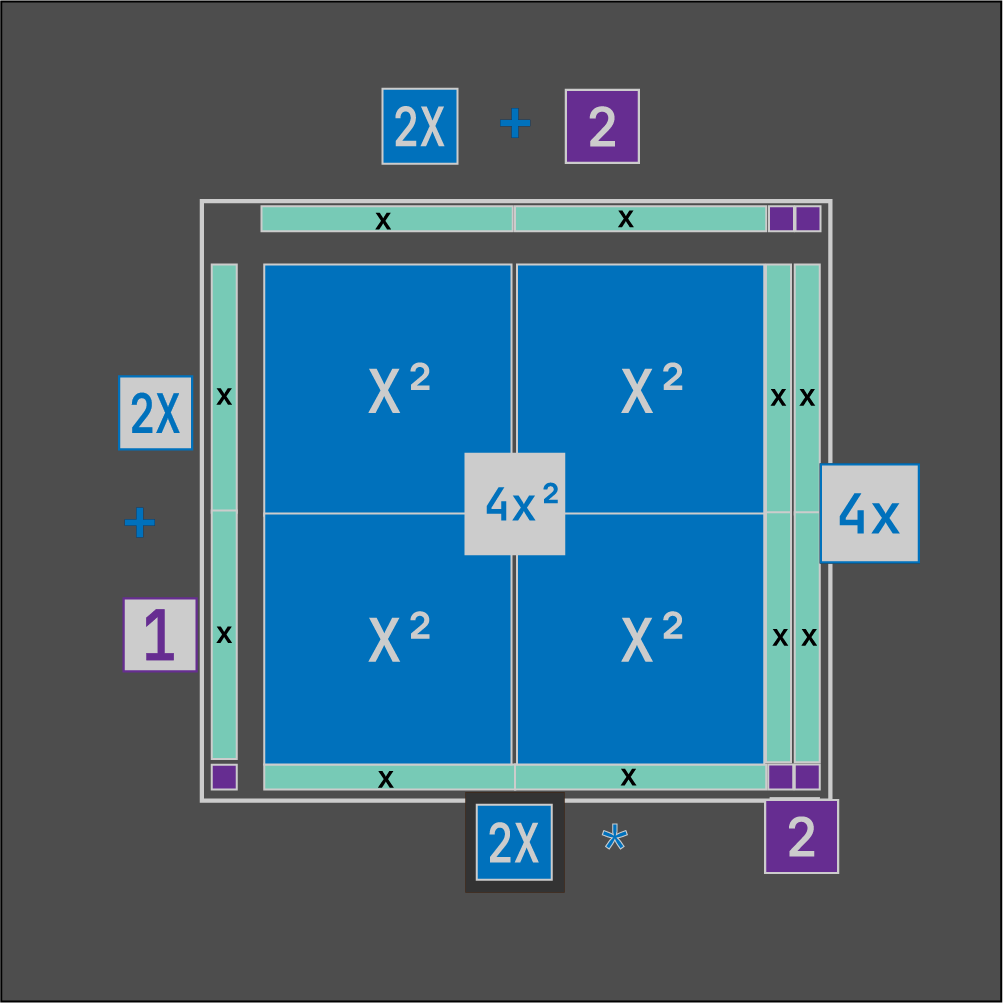
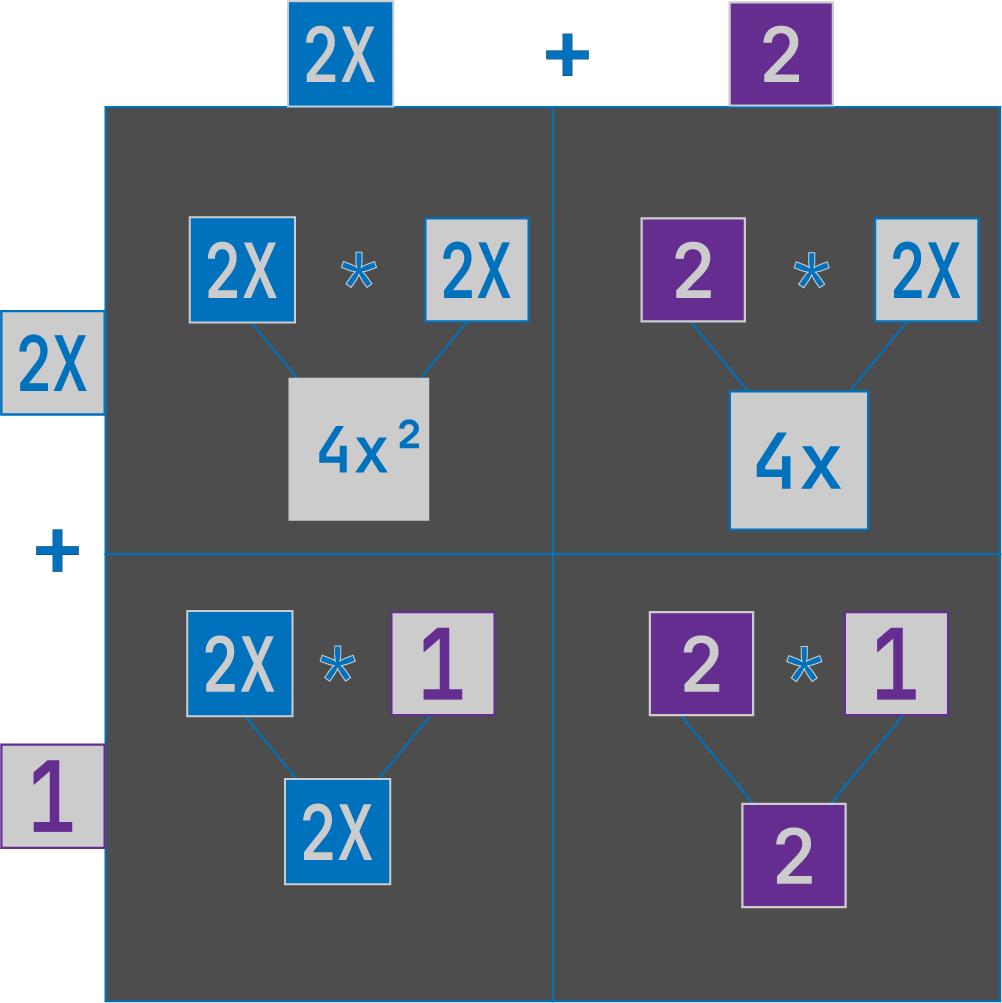
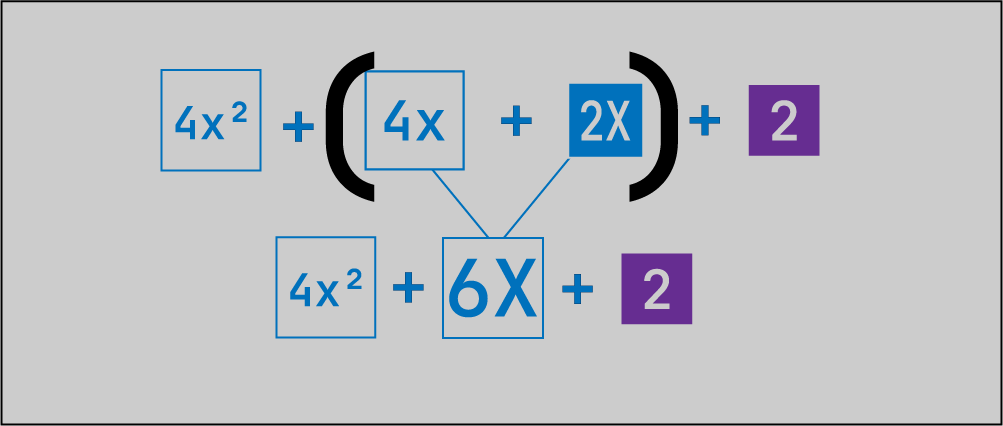
Now here is the key difference from arithmetic. With numbers, you just add the four partial products and get a single answer: 462. With variables, you can't collapse everything into one number. But you can combine the like terms. The 4x and the 2x are the cross-sections of the rectangle, just like the 40 and 20 were in arithmetic. They add up to 6x, and the result is a trinomial: 4x² + 6x + 2.
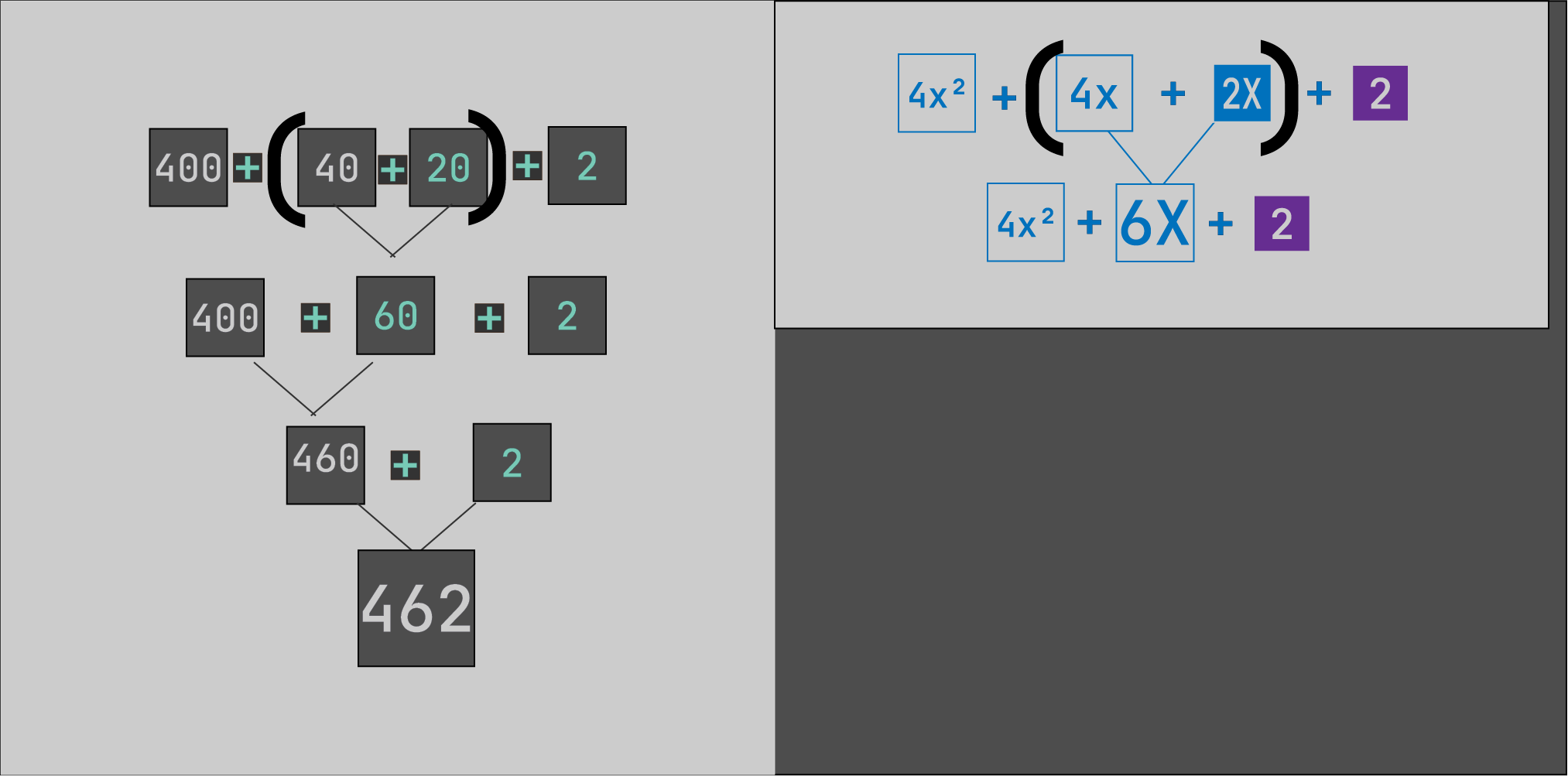
That middle term, 6x, is holding 4x and 2x the same way 462 is holding 40 and 20. The cross-sections force the rectangular shape. And this is why it matters: when you go backwards, when you divide or factor, the way those middle terms split apart determines the answer. In arithmetic, how the numbers regroup decides the quotient. In a quadratic, how the bx term splits determines the factorization.
The next year, when I had to prepare students to retake the Algebra I STAAR, I was disappointed to discover something: the test requires students to factor and multiply binomials, but there is no area model on it. The 4th-grade STAAR tests area model multiplication. The Algebra I STAAR tests factoring. But nobody connects them. Students learn the area model in 4th grade, forget it, and then learn distribution through FOIL in algebra as if it were a completely separate idea.
This felt like a massive lost opportunity. The area model could carry from 4th grade into 7th grade for multiplying fractions, into 8th grade for the Pythagorean theorem, and straight into Algebra I. Instead, students get FOIL, which is spatially difficult to follow. And the students who struggle the most with FOIL, students with dyslexia and dyscalculia, are exactly the ones who benefit most from spatial, visual structure. You're taking away the tool that would help them the most and replacing it with a mnemonic that connects to nothing.
These are the kind of domain discoveries that became the primitives of MathTabla. Not feature ideas. Not curriculum opinions. Structural observations about where the math itself provides a throughline that existing teaching methods abandon.
The Rectangle and 113
A week ago, while I was working with the AC method, I started thinking about imaginary numbers. I knew that some integers are the product of two complex conjugates. What I hadn't realized is that those integers are always the sum of two squares. Once I saw that, I started looking for examples and landed on 113, because 7² + 8² = 49 + 64 = 113.
So I wondered: could I use the box method to multiply the complex conjugates and get back to 113? Set up the rectangle with (7 + 8i) across the top and (7 − 8i) down the side. Four quadrants, same as always. Top left: 7 × 7 = 49. Top right: 7 × 8i = 56i. Bottom left: (−8i) × 7 = −56i. Bottom right: (−8i) × 8i = −64i². Since i² = −1, that last quadrant becomes 64.
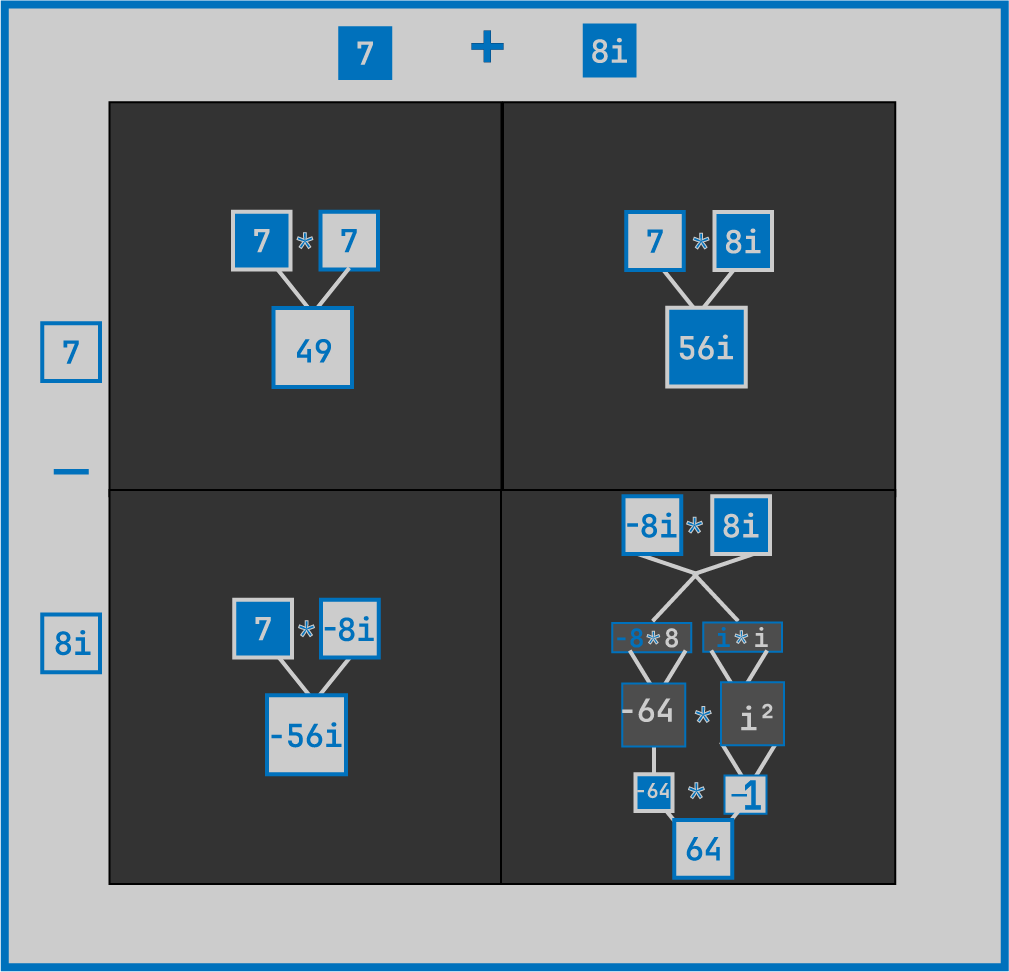
Now look at the cross-sections. The two middle terms are 56i and −56i. They cancel completely. The "bx" of this rectangle is zero. What's left is 49 + 0 + 64 = 113. A sum of two squares.
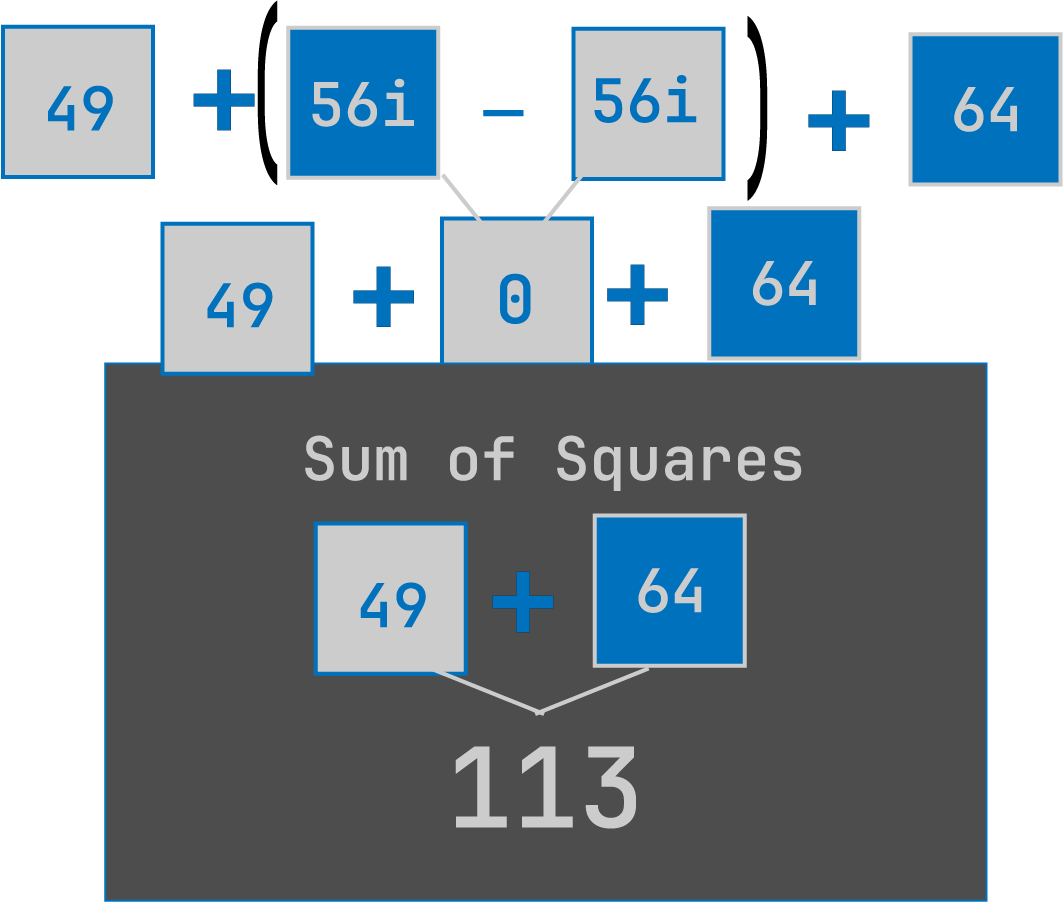
This is the same structure all three times. In 4th-grade arithmetic, the middle terms (40 + 20) add up to 60. In algebra, the middle terms (4x + 2x) combine into 6x. In complex multiplication with conjugates, the middle terms (56i − 56i) cancel to zero. The rectangle is the same. The constraint is the same. What changes is what happens in those cross-sections.
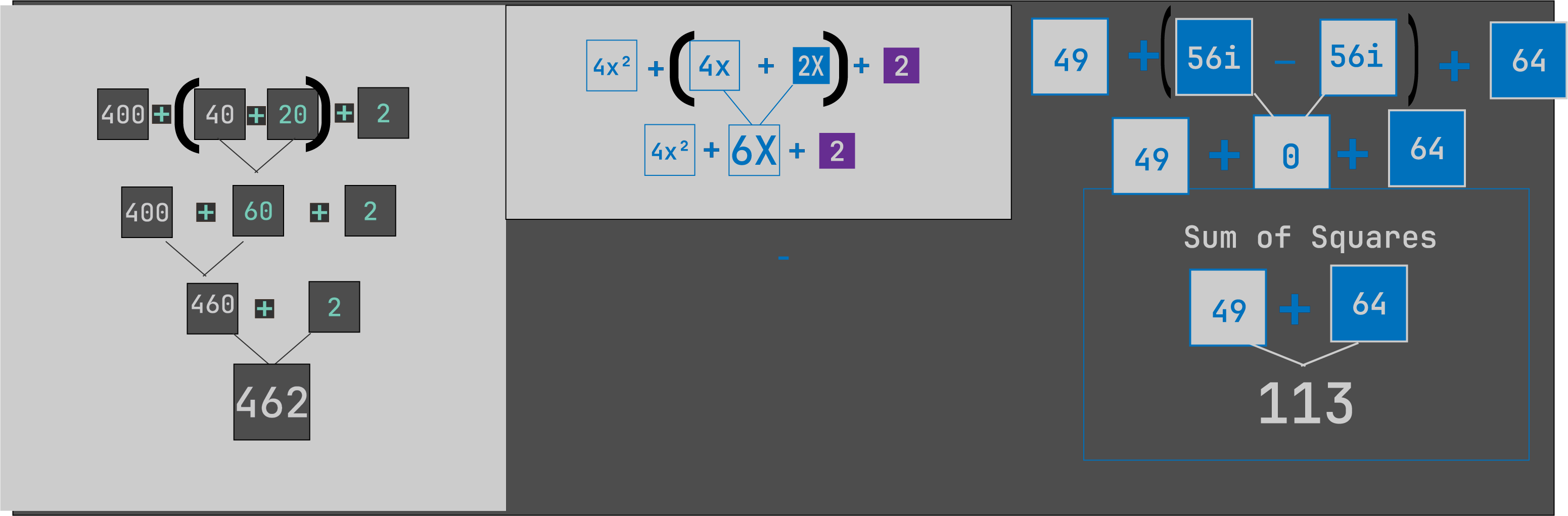
One rectangle. Three levels of math. The same four quadrants, the same cross-sections, the same constraint that the pieces must fit back into a rectangle. The only thing that changes is what happens in the middle.
In the next post, I'll show what happens when you run this rectangle backwards: how a student named Ian showed me the AC method, why "a times c" isn't the trick teachers think it is, and how the same box method that multiplies 22 × 21 can factor a quadratic, complete a square, and divide complex numbers. The rectangle doesn't stop.