
There's a special moment that happens when a student stops "doing algebra" and starts seeing it.
We're told systems of equations are about substitution and elimination, but for a lot of kids those words might as well be decorative wallpaper. They memorize steps without understanding what the steps mean. And when the steps fail, their sense of math collapses.
This is where tools like Cuisenaire® rods1 earn their place. They turn equations into physical ideas: lengths, areas, relationships. Students can push them around, compare them, reorganize them. Algebra becomes rearranging space.
But I want to make a stronger claim than "manipulatives help." I want to argue that the physical action of rotating a rod is substitution—not a metaphor for it, not preparation for it, but the thing itself at the perceptual-motor level.
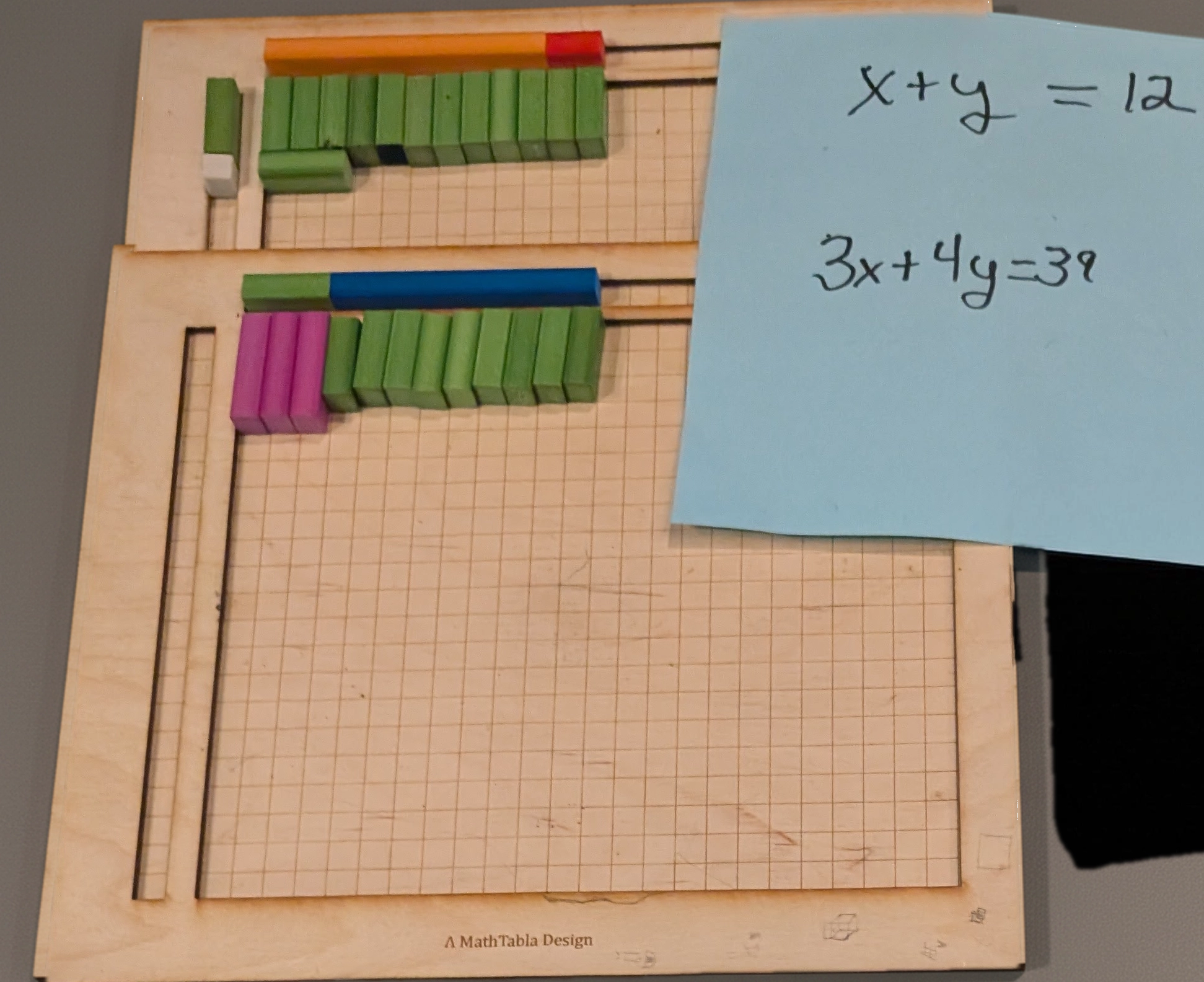
The Design Principle: Hubs and Shortcuts
One of the main design principles of MathTabla is to create hubs—representations that serve as shortcuts between different areas of mathematics.
I chose Cuisenaire® rods1 because they're already installed in students' minds. A 7th grader who used rods in kindergarten isn't learning a new tool; they're reactivating a network that already exists. The cognitive infrastructure is there. My job is to show them it extends further than they thought.
This isn't just intuition. Neuroscientist Joaquín Fuster describes how memory and action are organized hierarchically in the brain through what he calls cognits—networks of neurons that represent units of knowledge. These cognits are arranged from low-level sensory-motor patterns up to abstract conceptual understanding, with bidirectional connections between them.
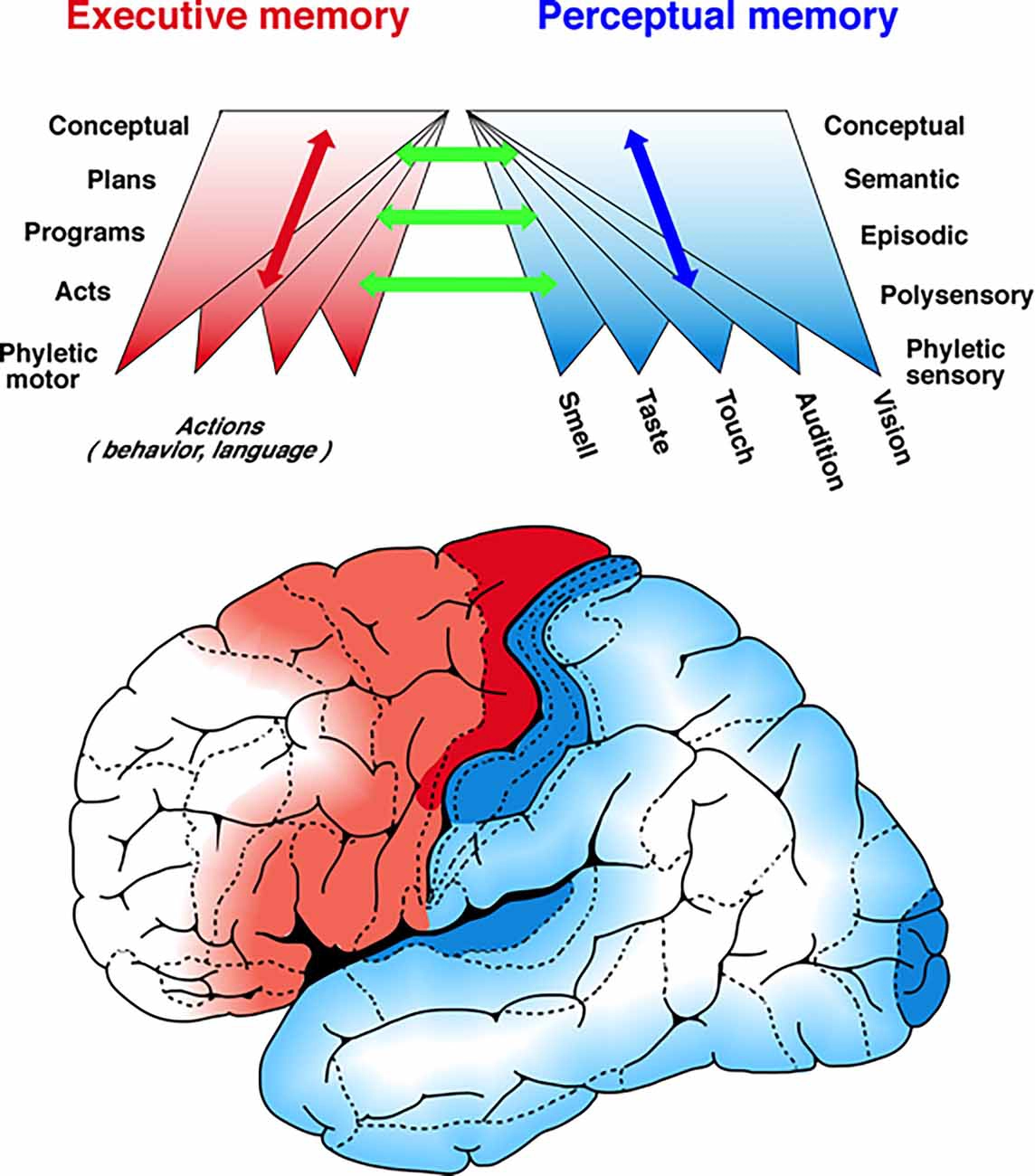
When a student picks up a rod they handled years ago, they're not building from scratch. They're entering an existing network and extending it upward toward more abstract territory. The rod is a hub that connects counting, length, area, multiplication, and—as I'll show—algebraic substitution.
The Problem
We're solving this system:
Traditionally, you'd teach substitution: solve the first equation for , plug it into the second, simplify, solve. It works. But students often execute the steps without understanding why they work—and when they hit an unfamiliar variation, they're lost.
Here's a different approach: what if the variables aren't abstract unknowns, but counts of things you can touch?
Reframing: Variables as Counts
Let's reinterpret the system:
- = how many 3-rods you have
- = how many 4-rods you have
The first equation, , says: you have 12 rods total.
The second equation, , says: the total length of all your rods is 39.
Now the problem becomes concrete: I have 12 rods. Some are length 3, some are length 4. How many of each do I need so the total length is 39?
The Physical Solution
Start by assuming all 12 rods are 3-rods. That gives you:
But you need 39. You're short by 3.
Here's the key insight: every time you swap a 3-rod for a 4-rod, you gain 1 unit of length. The rod count stays the same (still 12 rods), but the total length increases by 1.
To gain 3 units, you swap 3 rods.
So: (three 4-rods) and (nine 3-rods).
Check:
- Count: ✓
- Length: ✓
This isn't guess-and-check. The constraint eliminates guessing. It's constraint satisfaction through physical rearrangement—the student isn't hunting for an answer but constructing it from the structure of the problem.
Where the Rotation Happens
On the MathTabla board, this solution has a physical form.
You start with 12 rods of length 3, laid out to show if were 12. But you need 39. The deficit is 3.
Those 3 extra units can't appear from nowhere—they have to come from within the constraint. Here's the manipulation:
- Take 3 unit cubes (the deficit) and place one on top of each of three 3-rods.
- Each of those rods is now 4 units tall.
A rod of height 4 is a . You've converted three 's into three 's by rotating the unit from a horizontal extension into a vertical addition.
That rotation converts repeated addition into area. Three 3-rods stacked vertically give you height 3 and width 3. Add one unit to each, and you have height 4 and width 3. The rectangle is .
And is the same as . The rotation doesn't change the area; it changes which dimension carries the coefficient.
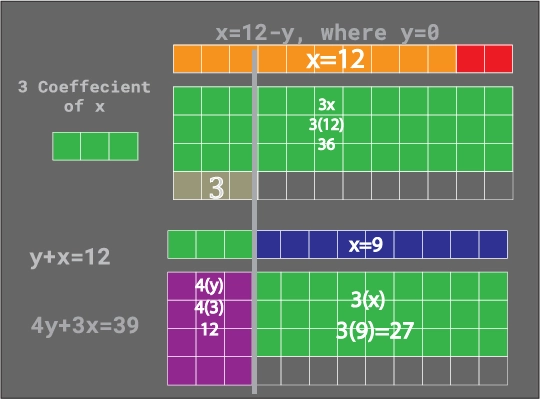
This is substitution. Not as a symbolic rewrite, but as a physical transformation. The rod that was "counted as " becomes "counted as " when you rotate it into a different dimensional role.
Why This Only Works Cleanly With Integers
There's an honesty I want to maintain here: this representation works beautifully when solutions are integers. When they're not, the model gets harder.
The rotation trick relies on lengths and counts being interchangeable. If , then a rod of length 3 can represent both the value of and the count of how many 's you have (when used as a dimension). That symmetry breaks when .
But I don't see this as a failure. I see it as the model revealing why mathematics needed to extend beyond counting numbers. The breakdown isn't a bug; it's a feature. It shows students the boundary of one representation and motivates the need for another.
What Students Learn That Worksheets Can't Teach
When kids work with Cuisenaire® rods1 like this, they experience things that no paper procedure captures:
Structure.
Equations aren't rules; they're spatial relationships. The system of equations is two different views of the same pile of rods.
Equivalence.
Rearranging doesn't change meaning; it reveals it. The total area is 39 whether you see it as rows or columns.
Substitution.
Not a symbolic trick—a rotation. The physical action of turning a rod is the cognitive operation of replacing one expression with another.
Constraint.
Both equations must fit the same reality. You can't just invent rods; you have to work within the 12 you're given.
In short, they learn what algebra is.
The Cognitive Science: Perception–Action Cycles
Fuster's work on the perception–action cycle helps explain why this approach works.
In his model, cognition isn't a one-way street from perception to thought to action. It's a loop: you perceive, you act, your action changes the environment, you perceive the change, you act again. This cycle runs through hierarchies of abstraction, from raw sensory-motor patterns up to conceptual reasoning.
When a student rotates a rod, they're not just "using a manipulative." They're running a perception–action cycle that physically instantiates the algebraic operation. The rotation is the substitution at the motor level. The perception of the new arrangement—three 4-rods instead of three 3-rods plus some extra units—is the recognition of the solution at the perceptual level.
The symbolic procedure students later learn in textbooks is an abstraction of this more fundamental loop. And because the physical version came first, the symbolic version has somewhere to land in their cognit network. It's not floating in abstract space; it's grounded in the hands.
Why I'm Rebuilding These Lessons Digitally
In my classroom, this approach turned repeat-fail students into confident problem-solvers. The problem was scale. Physical rods don't live well inside online test-prep platforms.
So I started building digital manipulatives that behave like real rods:
- They snap into place.
- They resize proportionally.
- They stack and overlay.
- They visually encode coefficients, sums, and comparisons.
- And they animate so students feel the "click" of understanding.
The goal isn't to gamify algebra. It's to restore a way of thinking that used to happen naturally when math was hands-on.
The Core Insight
If I had to distill this entire approach into one sentence, it would be:
Variables aren't unknowns to solve for. They're counts of things you can touch. The system asks: how do I sort these rods so the totals work out?
And substitution? That's not replacing a symbol with an expression.
Substitution is rotating a rod.
What's Next
This system-of-equations model is part of a broader project—MathTabla—where I'm designing interactive, tactile algebra experiences for students who need conceptual grounding before symbolic fluency.
The rods a student used in kindergarten can carry them all the way to 7th-grade algebra and beyond. They just need someone to show them the hub was there all along.
Math doesn't have to be silent or static. Kids learn by arrangement, not by scripts.
- Cuisenaire® and the sequence and selection of colors of all Cuisenaire® Rods are a registered trademark of hand2mind, Inc. The sequence and selection of colors of all fraction pieces are a trademark of Learning Resources, Inc. ↩